The Honourable Julie Dabrusin
House of Commons
Ottawa, ON K1A 0A6
Email: julie.dabrusin@parl.gc.ca
The Honourable Joanne Thompson
House of Commons
Ottawa, ON K1A 0A6
Email: joanne.thompson@parl.gc.ca
The Honourable Nathalie Provost
House of Commons
Ottawa, ON K1A 0A6
Email: nathalie.provost@parl.gc.ca
Subject: Strengthening Blue Carbon Objectives in Canada’s Climate & Biodiversity Commitments
Dear Minister Dabrusin, Minister Thompson and Secretary Provost,
We are writing as early-career researchers with Blue Carbon Canada[1] who are working to develop national- and regional-level syntheses for Canada’s blue carbon ecosystems - tidal marshes, eelgrass meadows, kelp forests, and marine seabed sediment - that strengthen the scientific evidence base needed to inform climate and biodiversity policy frameworks. Our published and forthcoming research outputs highlight the need for stronger recognition and protection of blue carbon ecosystems in Canada’s international commitments under the United Nations Framework Convention on Climate Change (UNFCCC), the Convention on Biological Diversity (CBD), and in domestic policies that synergize climate and biodiversity objectives.
With a national synthesis of all blue carbon ecosystems underway, Blue Carbon Canada has already completed an evaluation of the blue carbon capacity of Canada’s kelp forests and a predictive model of organic carbon stocks in surficial sediments along Canada’s continental margin (see Appendix for key figures). As an example of the importance of these ecosystems, it is estimated that the top 30 centimeters of Canada’s marine sediments, at depths up to 2,500 meters, store approximately 10.9 billion tonnes of organic carbon. This is equivalent to roughly 78% of the total carbon contained in standing trees throughout Canada’s forests.[2]
The time to recognize the importance of these ecosystems in Canada’s climate and biodiversity policy frameworks is now. Canada signed the Blue NDC Challenge at UNFCCC COP30 in November 2025, pledging to include ocean-based climate action such as the sustainable management, conservation, and restoration of coastal and marine ecosystems within its Nationally Determined Contributions (NDCs). Canada further articulated support for ocean-based climate action at the 2025 Ocean and Climate Change Dialogue, encouraging Parties to integrate ocean-based measures into their NDCs and implementation strategies.
As Canada seeks to meet its 2030 marine conservation targets and more fully understand the effectiveness of existing protections, we first need to ensure that an enabling governance framework for blue carbon is in place. To establish this framework and support the implementation of relevant national and international commitments, we recommend the following actions.
1) Update Canada’s NDCs prior to the UNFCCC COP31 in November 2026 to explicitly recognize the carbon storage capacity of Canada’s blue carbon ecosystems including tidal marshes, seagrass meadows, kelp forests and unvegetated marine sediment.[3] The methodologies for including tidal marshes and seagrass meadows are well established, and the science to support inclusion of seabed sediments and kelp forests is rapidly developing. 62 countries have already included considerations for blue carbon in their 2021 NDCs.[4]
2) Include blue carbon ecosystem protection as an explicit criterion in achieving Canada’s target to protect 30% of marine areas by 2030.[5]Existing planning efforts, such as the Scotian Shelf bioregional MPA network, prioritize the protection of biogenic habitat with high blue carbon potential, including eelgrass, saltmarsh, kelp, rockweed, and other macro-algae. Achieving 30% protection targets for these habitats, while also expanding conservation priorities to include all blue carbon ecosystems within 30x30 planning, would maximize the climate mitigation potential of new protected areas.
3) Leverage co-benefits to strengthen blue carbon protection within Canada’s National Adaptation Strategy. Advance the NAS’s guiding principle to maximize co-benefits for the economy and the natural environment by prioritizing the conservation, restoration, and sustainable management of blue carbon ecosystems. These actions would also help achieve Canada’s nature and biodiversity objectives by accelerating the use of nature-based solutions to enhance climate resilience.
4) Expand capacity for measuring, monitoring, reporting, and verifying Canada’s significant blue carbon assets. This includesadvancing efforts to standardize Intergovernmental Panel on Climate Change (IPCC) methodologies to allow for the recognition of kelp and marine sediment carbon storage capacity in Canada’s greenhouse gas inventory.
Our forthcoming national blue carbon quantification can support the implementation of these recommendations by providing updated maps of ecosystem extent, national carbon storage estimates, and estimated pathways for avoided emissions from expanded protections.
We welcome the opportunity to further explore specific language that could be integrated into Canada’s NDCs and support the inclusion of blue carbon ecosystems and their biodiversity co-benefits in Canada’s marine and coastal management. Thank you for your leadership on ocean and climate issues and for your consideration of these recommendations.
Sincerely,
Bryce O’Brien – PhD Student, Biology
University of Victoria
bryceobrien@uvic.ca
Madeleine Fry – MSc Student, Forest and Conservation Science
University of British Columbia
Dr. Kylor Kerns – Postdoctoral Research Fellow, Forest and Conservation Science
University of British Columbia
Dr. Miao Li – Postdoctoral Research Fellow, Biology
University of Victoria
Dr. Jennifer McHenry – Senior Research Fellow, Biology
University of Victoria
Cc:
Niall O’Dea, Senior Assistant Deputy Minister, Strategic Policy, Fisheries and Oceans Canada; Niall.Odea@dfo-mpo.gc.ca
Michael Bonser, Associate Assistant Deputy Minister, Environment and Climate Change Canada; Michael.Bonser@ec.gc.ca
Kaili Levesque, Associate Deputy Minister of Innovation, Science, and Economic Development; Kaili.Levesque@ised-isde.gc.ca
Appendix:
Fig. 1. Estimates of organic carbon density (kg m-3) across the Canadian continental margin (Epstein et al., 2024)
Estimates of organic carbon density (kg m−3) across the Canadian continental margin. The main plot shows the Arctic and Atlantic regions with the Pacific region inset. The continuous variable is shown in discrete color bands to improve visualization of highly right-skewed data. The estimated bounds of uncertainty around the predicted means are shown in Fig. E4. Labels indicating the locations of the different areas mentioned within the text are shown in Fig. B3. Country outlines from World Bank Official Boundaries, available at https://datacatalog.worldbank.org/search/dataset/0038272 (last access: 16 May 2023).
Fig. 2. National blue carbon capacity of Canadian kelp forests across all three oceans (McHenry et al., 2025)
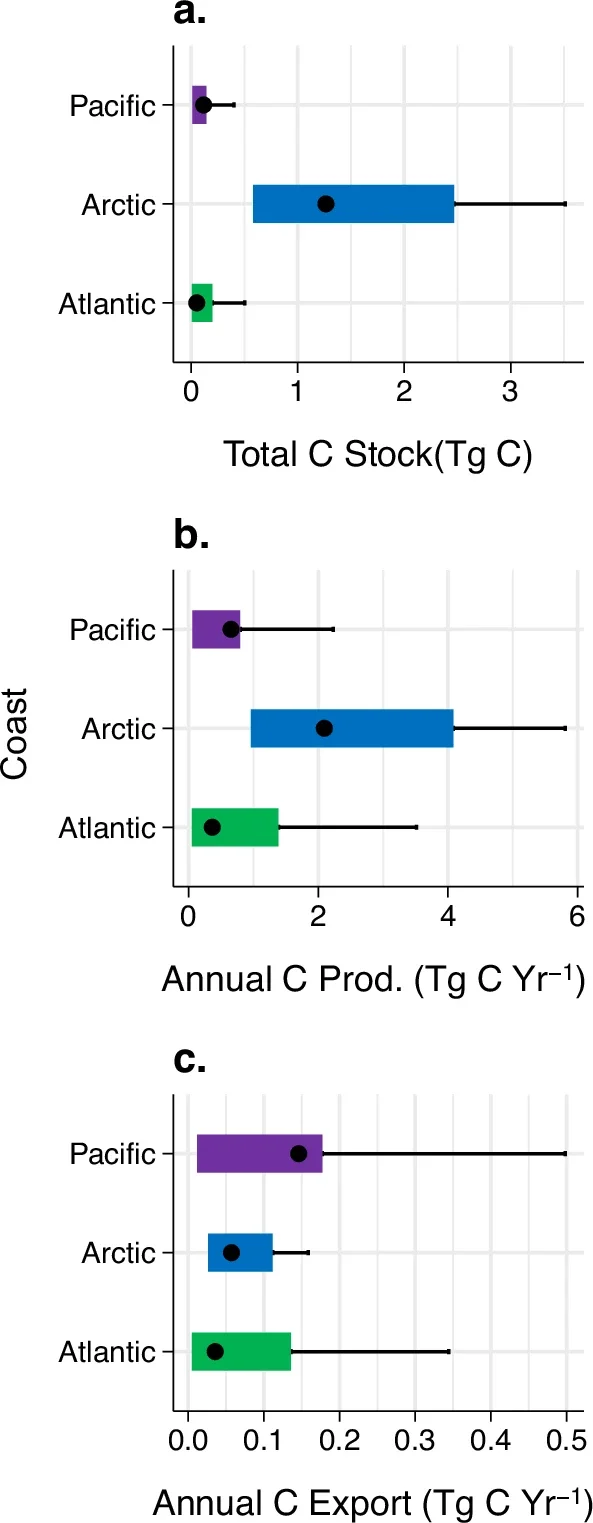
National blue carbon capacity of Canadian kelp forests. Panels show the total estimated (a) standing carbon stocks (Tg C), b carbon production (Tg C yr-1), and (c) carbon export (Tg C yr1) capacity of kelp forests. The bars depict the high and low estimates per coast. The circle represents the median estimates for each coast. Error bars show the maximum potential capacity per coast.
[1] Blue Carbon Canada is an NSERC Alliance funded initiative headquartered at the University of Victoria in partnership with Parks Canada and the Department of Fisheries and Oceans.
[2] Söthe, C., Gonsamo, A., Arabian, J., Kurz, W.A., Finkelstein, S.A. and Snider, J. (2022) Large soil carbon storage in terrestrial ecosystems of Canada. Global Biogeochemical Cycles, 36(2), e2021GB007213. Available at: https://doi.org/10.1029/2021GB007213.
[3] Indonesia has incorporated mangroves into its national GHG inventory and is developing seagrass mapping and GHG estimation methodologies for future NDC integration (Republic of Indonesia, Second NDC, 2025). The UK has also committed to filling evidence gaps to enable the future inclusion of saltmarsh in its national GHG inventory (United Kingdom of Great Britain and Northern Ireland, 2035 Nationally Determined Contribution, 2025).
[4] Lecerf, M., Herr D., Elverum, C., Delrieu, E. and Picourt, L. (2023) Coastal and marine ecosystems as nature-based solutions in new or updated Nationally Determined Contributions. Ocean & Climate Platform, Conservation International, IUCN, Rare, The Nature Conservancy, Wetlands International and WWF. Available at: https://ocean-climate.org/wp-content/uploads/2023/10/NDC_Analysis_2023.pdf
[5] Fiji’s latest NDC commits to achieving 30% marine protected area coverage and restoring blue carbon ecosystems as adaptation measures (Fiji, NDC 3.0, 2025). Similarly, Indonesia and Cambodia emphasize expanding marine protected areas alongside improved regulation and management to enhance blue carbon ecosystem services (Kingdom of Cambodia, NDC 3.0, 2025), Republic of Indonesia, Second NDC, 2025).