Science Policy EngagementWe believe that our science should not stop at publication, but we should also interact with policymakers. Below are some of these efforts.
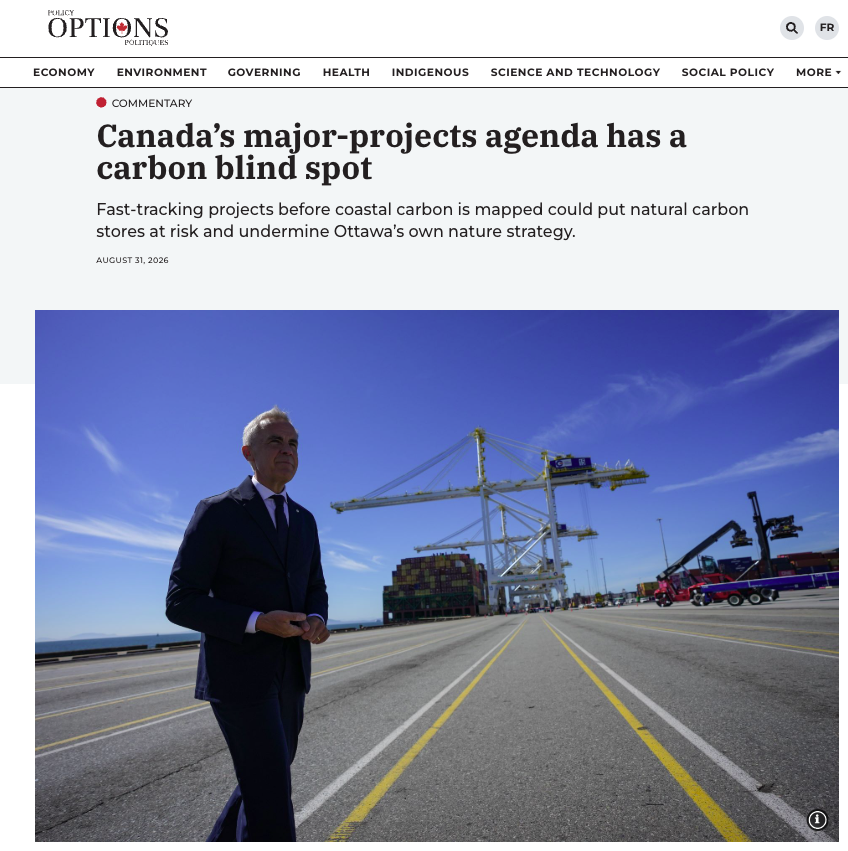
While the government is reviewing the feedback it received from the ‘Major Projects’ discussion paper and is in its pre-legislation stage, Dr. Jenn McHenry and Bryce O’Brien published an article in Policy Options to provide further information to the public and policymakers. August 2026
In June 2026, following the release of the ‘Major Projects’ discussion paper by the government, the PDFs, PhD students, and research assistants of BCC wrote a public response letter to the government outlining the concerns surrounding blue carbon and the proposed changes and actions. Following this, we shared our letter on LinkedIn. The body of the letter can be found below or as a PDF version via the button.
-
The Privy Council Office
Government of Canada
Submitted electronically to: engagement@pco-bcp.gc.ca
Response to ‘Getting Major Projects Built in Canada - Discussion Paper on Proposed
Legislative, Regulatory, and Policy Reforms’ (July 22, 2026)
Dear Privy Council Office,
We are writing as early-career researchers affiliated with the Blue Carbon Canada (BCC) program, where we conduct research on the role of coastal and marine ecosystems in supporting Canada’s climate action, biodiversity conservation, and sustainable development goals. We have reviewed the Government of Canada’s discussion paper Getting Major Projects Built in Canada, and are deeply concerned about the implications of several proposed legislative and regulatory changes.
We recognize that Canada faces significant challenges related to its economic competitiveness, trade, energy security, and transition to a lower carbon economy. Improving coordination and reducing unnecessary inefficiencies in project review processes are worthwhile goals, especially in pursuit of a clean energy transition. However, accelerating major project approvals should not come at the expense of the critical environmental safeguards, scientific review processes, and public engagement mechanisms that protect our ecosystems and communities.
In particular, we are deeply concerned by the proposals to:
● Compress timelines for environmental review and consultations with Indigenous Peoples;
● Exempt certain major projects from impact assessment requirements;
● Allow project approvals and construction activities to proceed before environmental and safety reviews are complete;
● Expand reliance on habitat offsetting as compensation for avoidable environmental impacts;
● Create exemptions that would significantly weaken protections for species at risk.
Together, these proposed reforms risk undermining the scientific rigor, transparency, and accountability that environmental review processes are intended to provide. Impact assessments are not administrative hurdles. They are essential tools for identifying environmental and societal risks, evaluating cumulative impacts, assessing long-term trade-offs, and ensuring that projects proceed in a manner that minimizes potential harms. Weakening or bypassing these processes drastically increases the likelihood that such harms will be overlooked or inadequately addressed.
Canada must uphold its commitments to nature
We support the government’s vision of Canada as a domestic and international leader in protecting, restoring, and valuing nature as set out in A Force of Nature: Canada's Strategy to Protect Nature 2026 (hereafter Nature Strategy) [1]. The Nature Strategy frames conservation and economic development as complementary and not competing priorities. Yet the proposed reforms laid out in the major projects' discussion paper seem to directly contradict this framing, eliminating key elements of the environmental impact review process that would make sustainable development possible.
Central to the Nature Strategy is the mitigation hierarchy, which states that development should first avoid impacts, then minimize or mitigate them, and only offset what remains through protection or restoration elsewhere. However, the increased flexibility for habitat offsetting outlined in the proposal would invert this hierarchy, elevating offsetting from a last resort to a higher priority instrument. This is not only inconsistent with best practices outlined by biodiversity conservation science, but also with the government's own stated commitments.
The Nature Strategy also outlines measures to streamline permitting by mapping nature, identifying key biodiversity areas, and using regulatory input to improve project design to avoid and minimize environmental impacts. But the proposed reforms could allow development to proceed without a clear understanding of risks to biodiversity, and without the scientific input that project design depends on.
Furthermore, the Nature Strategy pledges to strengthen protection and recovery of species-at-risk, the number of which has increased by 188% since 2003. Yet the conditions for proposed exemptions to the species-at-risk jeopardy test are so ambiguously defined that they could be far too broadly applied, putting these species at further risk. This sets out a dangerous precedent at a time when many species at risk are already facing rapidly intensifying climate change impacts and other sources of disturbance.
In light of these concerns, we strongly urge the government to uphold the values and goals of the Nature Strategy by continuing to follow the mitigation hierarchy, maintaining transparent and thorough environmental impact assessments, and upholding strong protections for species-at-risk.
Canada must follow through on its climate change goals
As researchers working on the science to support natural climate solutions in Canada, we are particularly concerned about how the proposed reforms would impact Canada’s ability to meet its own climate commitments. Like other parties to the Paris Climate Accord and subsequent agreements, Canada has committed to drastically reducing its emissions and enhancing carbon uptake through both technological and nature-based solutions. Yet many of the >15 major projects under consideration [2] —including pipelines, transmission corridors, offshore energy terminals, and associated infrastructure—have the potential to directly or indirectly impact forests, grasslands, wetlands, and other coastal habitats that currently function as valuable long-term carbon sinks. Much of the carbon stored in these ecosystems has been accumulating for over centuries to millennia, and once lost, will not be recoverable within the time we have left to fight the climate crisis. Through our own work within BCC, we have found that coastal ‘blue carbon’ ecosystems—including seabed sediments, tidal marshes, and seagrass meadows nationally hold >10 Gt of carbon, the majority of which is considered under- or unprotected by current spatial protections [3, 4, 5]. These ecosystems are therefore directly exposed to the types of coastal and nearshore development being proposed.
Without a rigorous environmental review process, the full impacts of these projects on Canada’s natural carbon stores and long-term climate mitigation capacity cannot be adequately identified or considered.
Compressing assessment timelines further increase the likelihood that these impacts are overlooked. At a time when Canada should be rapidly scaling its renewable energy sector and reducing its greenhouse gas emissions from industries and natural ecosystems, development decisions must be informed by a full accounting of their impacts on both built and natural assets.
Canada must honor its international agreements
Importantly, the proposed reforms place Canada’s domestic policy direction in conflict with its own stated leadership on international biodiversity, climate, and sustainable development commitments. Canada has positioned itself as a leader in biodiversity conservation through its role in securing the Kunming-Montréal Global Biodiversity Framework [1], in ocean-based climate action by signing onto the Blue NDC Challenge [6], and in long-term decarbonization through the Canadian Net-Zero Emissions Accountability Act [7] and its updated industrial carbon pricing trajectory [8]. Through the United Nations 2030 Agenda for Sustainable Development, Canada has also committed to advancing a shared global framework for a more sustainable, equitable, and resilient future. Canada’s own 2023 Voluntary National Review of the Sustainable Development Goals identified climate action, partnerships, transparency, accountability, and policy coherence as essential to advancing this agenda, and recognized resilient ecosystems as central to carbon storage, emissions reductions, and climate adaptation [8]. Weakening environmental assessment and regulatory safeguards would directly undermine these priorities by reducing the evidence and accountability needed to ensure major projects align with SDG 13 (climate action), SDG 14 (life below water), SDG 15 (life on land), and SDG 16 (strong institutions).
Further, the case for these reforms has been framed almost entirely in economic terms without considering the cost of ignoring Canada’s immense natural capital. Canada’s own ecosystem accounts show that ocean and coastal ecosystems already provide measurable economic value, with carbon sequestration, wild fish and seafood, and nature-based tourism alone contributing at least $7.1 billion in 2023 alone [9]—just a fraction of the services these ecosystems provide. Fast-tracking major projects by weakening environmental safeguards therefore would risk more than environmental harm; it undervalues the natural capital that already supports communities and regional economies.
We urge Canada’s government to not trade away the long-term resilience of our diverse ecosystems, and the services and values Canadians derive from them, for short-term project approval timelines.
Canada must follow through on its reconciliation commitments
Finally, despite all being settlers or visitors on Indigenous lands, we believe reconciliation is the work of all peoples who call Canada home. We are therefore deeply concerned that compressed review and decision-making timelines will weaken opportunities for meaningful consultation and engagement with Indigenous rightsholders. In Canada, Indigenous groups and communities have been disproportionately impacted by extractive and natural resources development for generations, while being systematically excluded from decisions affecting their inherent rights. The Government of Canada’s endorsement of the United Nations Declaration on the Rights of Indigenous Peoples (UNDRIP) [10] and the following Royal Assent of the United Nations Declaration on the Rights of Indigenous Peoples Act (UNDA) [11] represent important steps towards reconciliation and cooperative, fair democracy in Canada. We generally support some of the intentions put forward in the discussion paper around engaging with Indigenous communities in a meaningful way, early in the review process, and addressing issues with consultation fatigue. However, despite these good intentions, we believe some of the proposals have the potential to undermine Canada’s commitments under UNDA.
Canada has a constitutional duty to consult Indigenous Peoples when considering measures that might adversely impact their potential or established Aboriginal or treaty rights. The UNDA Action Plan 2023-2028 [12] states that Indigenous peoples must have the opportunity “to participate in and to positively influence federal decision-making processes with adequate time and supported by adequate resources”. A one-year deadline for all reviews and decisions is incompatible with this standard and risks rushed, inadequate consultation that deepens consultation fatigue among Indigenous Peoples. The UNDA Action Plan further commits Canada to developing guidance on engaging with Indigenous peoples on natural resource projects consistent with Article 32(2) of UNDRIP, which calls for free, prior and informed consent, prior to the approval of any project affecting their lands or territories. The government's proposal directly contradicts UNDRIP by allowing project approval and construction to commence before environmental and safety reviews are complete. This implies that construction could begin before Indigenous communities are properly consulted as a part of the review process, continuing Canada’s shameful legacy of excluding Indigenous Peoples from decisions impacting their rights, lands and waters.
We strongly urge the Government of Canada not to set aside years of progress towards its reconciliation commitments. Beyond being ethically wrong, doing so is likely to lead to further legal challenges, distrust, and delays that these reforms purport to avoid.
Conclusion
As Canada seeks to reduce its greenhouse gas emissions and maintain its position as an environmental leader, it is essential that we maintain robust environmental policies and evidence-based regulatory frameworks to ensure that major projects proceed in a manner consistent with long-term climate, biodiversity, and sustainability goals. We respectfully urge the Government of Canada to not weaken the critically needed environmental safeguards we have in pursuit of short-term economic gains. Canada can support responsible economic development and the clean energy transition without compromising the scientific and legal safeguards that protect our ecosystems and communities.
Thank you for your time and consideration.
Sincerely,
Dr. Jennifer McHenry - Senior Postdoctoral Fellow, Department of Biology, University of Victoria
Dr. Kylor Kerns – Postdoctoral Fellow, Department of Forestry and Conservation Sciences, University of British Columbia
Matthew Csordas – PhD Candidate, Department of Biology, University of Victoria
Madeleine Fry – MSc Student, Department of Forestry and Conservation Sciences, University of British Columbia
Bryce O’Brien – PhD Student, Department of Biology, University of Victoria
Dr. Miao Li – Postdoctoral Fellow, Department of Biology, University of Victoria
Vanessa Valenti – Research Technician, Department of Zoology & Biodiversity Research Centre, University of British Columbia
In March 2026, we submitted a formal letter to Minister Dabrusin (ECCC), Minister Thompson (DFO), and Secretary Provost (Nature) outlining opportunities to strengthen blue carbon protections within Canada’s climate and biodiversity commitments. Following this, we shared our letter on LinkedIn. The body of the letter and appendix figures can be found below or as a PDF version via the button.
-
Subject: Strengthening Blue Carbon Objectives in Canada’s Climate & Biodiversity Commitments
Dear Minister Dabrusin, Minister Thompson and Secretary Provost,
We are writing as early-career researchers with Blue Carbon Canada[1] who are working to develop national- and regional-level syntheses for Canada’s blue carbon ecosystems - tidal marshes, eelgrass meadows, kelp forests, and marine seabed sediment - that strengthen the scientific evidence base needed to inform climate and biodiversity policy frameworks. Our published and forthcoming research outputs highlight the need for stronger recognition and protection of blue carbon ecosystems in Canada’s international commitments under the United Nations Framework Convention on Climate Change (UNFCCC), the Convention on Biological Diversity (CBD), and in domestic policies that synergize climate and biodiversity objectives.
With a national synthesis of all blue carbon ecosystems underway, Blue Carbon Canada has already completed an evaluation of the blue carbon capacity of Canada’s kelp forests and a predictive model of organic carbon stocks in surficial sediments along Canada’s continental margin (see Appendix for key figures). As an example of the importance of these ecosystems, it is estimated that the top 30 centimeters of Canada’s marine sediments, at depths up to 2,500 meters, store approximately 10.9 billion tonnes of organic carbon. This is equivalent to roughly 78% of the total carbon contained in standing trees throughout Canada’s forests.[2]
The time to recognize the importance of these ecosystems in Canada’s climate and biodiversity policy frameworks is now. Canada signed the Blue NDC Challenge at UNFCCC COP30 in November 2025, pledging to include ocean-based climate action such as the sustainable management, conservation, and restoration of coastal and marine ecosystems within its Nationally Determined Contributions (NDCs). Canada further articulated support for ocean-based climate action at the 2025 Ocean and Climate Change Dialogue, encouraging Parties to integrate ocean-based measures into their NDCs and implementation strategies.
As Canada seeks to meet its 2030 marine conservation targets and more fully understand the effectiveness of existing protections, we first need to ensure that an enabling governance framework for blue carbon is in place. To establish this framework and support the implementation of relevant national and international commitments, we recommend the following actions.
1) Update Canada’s NDCs prior to the UNFCCC COP31 in November 2026 to explicitly recognize the carbon storage capacity of Canada’s blue carbon ecosystems including tidal marshes, seagrass meadows, kelp forests and unvegetated marine sediment.[3] The methodologies for including tidal marshes and seagrass meadows are well established, and the science to support inclusion of seabed sediments and kelp forests is rapidly developing. 62 countries have already included considerations for blue carbon in their 2021 NDCs.[4]
2) Include blue carbon ecosystem protection as an explicit criterion in achieving Canada’s target to protect 30% of marine areas by 2030.[5]Existing planning efforts, such as the Scotian Shelf bioregional MPA network, prioritize the protection of biogenic habitat with high blue carbon potential, including eelgrass, saltmarsh, kelp, rockweed, and other macro-algae. Achieving 30% protection targets for these habitats, while also expanding conservation priorities to include all blue carbon ecosystems within 30x30 planning, would maximize the climate mitigation potential of new protected areas.
3) Leverage co-benefits to strengthen blue carbon protection within Canada’s National Adaptation Strategy. Advance the NAS’s guiding principle to maximize co-benefits for the economy and the natural environment by prioritizing the conservation, restoration, and sustainable management of blue carbon ecosystems. These actions would also help achieve Canada’s nature and biodiversity objectives by accelerating the use of nature-based solutions to enhance climate resilience.
4) Expand capacity for measuring, monitoring, reporting, and verifying Canada’s significant blue carbon assets. This includesadvancing efforts to standardize Intergovernmental Panel on Climate Change (IPCC) methodologies to allow for the recognition of kelp and marine sediment carbon storage capacity in Canada’s greenhouse gas inventory.
Our forthcoming national blue carbon quantification can support the implementation of these recommendations by providing updated maps of ecosystem extent, national carbon storage estimates, and estimated pathways for avoided emissions from expanded protections.
We welcome the opportunity to further explore specific language that could be integrated into Canada’s NDCs and support the inclusion of blue carbon ecosystems and their biodiversity co-benefits in Canada’s marine and coastal management. Thank you for your leadership on ocean and climate issues and for your consideration of these recommendations.
Sincerely,
Bryce O’Brien – PhD Student, Biology
University of Victoria
bryceobrien@uvic.caMadeleine Fry – MSc Student, Forest and Conservation Science
University of British ColumbiaDr. Kylor Kerns – Postdoctoral Research Fellow, Forest and Conservation Science
University of British ColumbiaDr. Miao Li – Postdoctoral Research Fellow, Biology
University of VictoriaDr. Jennifer McHenry – Senior Research Fellow, Biology
University of VictoriaCc:
Niall O’Dea, Senior Assistant Deputy Minister, Strategic Policy, Fisheries and Oceans Canada; Niall.Odea@dfo-mpo.gc.ca
Michael Bonser, Associate Assistant Deputy Minister, Environment and Climate Change Canada; Michael.Bonser@ec.gc.ca
Kaili Levesque, Associate Deputy Minister of Innovation, Science, and Economic Development; Kaili.Levesque@ised-isde.gc.ca
[1] Blue Carbon Canada is an NSERC Alliance funded initiative headquartered at the University of Victoria in partnership with Parks Canada and the Department of Fisheries and Oceans.
[2] Söthe, C., Gonsamo, A., Arabian, J., Kurz, W.A., Finkelstein, S.A. and Snider, J. (2022) Large soil carbon storage in terrestrial ecosystems of Canada. Global Biogeochemical Cycles, 36(2), e2021GB007213. Available at: https://doi.org/10.1029/2021GB007213.
[3] Indonesia has incorporated mangroves into its national GHG inventory and is developing seagrass mapping and GHG estimation methodologies for future NDC integration (Republic of Indonesia, Second NDC, 2025). The UK has also committed to filling evidence gaps to enable the future inclusion of saltmarsh in its national GHG inventory (United Kingdom of Great Britain and Northern Ireland, 2035 Nationally Determined Contribution, 2025).
[4] Lecerf, M., Herr D., Elverum, C., Delrieu, E. and Picourt, L. (2023) Coastal and marine ecosystems as nature-based solutions in new or updated Nationally Determined Contributions. Ocean & Climate Platform, Conservation International, IUCN, Rare, The Nature Conservancy, Wetlands International and WWF. Available at: https://ocean-climate.org/wp-content/uploads/2023/10/NDC_Analysis_2023.pdf
[5] Fiji’s latest NDC commits to achieving 30% marine protected area coverage and restoring blue carbon ecosystems as adaptation measures (Fiji, NDC 3.0, 2025). Similarly, Indonesia and Cambodia emphasize expanding marine protected areas alongside improved regulation and management to enhance blue carbon ecosystem services (Kingdom of Cambodia, NDC 3.0, 2025), Republic of Indonesia, Second NDC, 2025).
Appendix:
Fig. 1. Estimates of organic carbon density (kg m-3) across the Canadian continental margin (Epstein et al., 2024)
Estimates of organic carbon density (kg m−3) across the Canadian continental margin. The main plot shows the Arctic and Atlantic regions with the Pacific region inset. The continuous variable is shown in discrete color bands to improve visualization of highly right-skewed data. The estimated bounds of uncertainty around the predicted means are shown in Fig. E4. Labels indicating the locations of the different areas mentioned within the text are shown in Fig. B3. Country outlines from World Bank Official Boundaries, available at https://datacatalog.worldbank.org/search/dataset/0038272 (last access: 16 May 2023).
Fig. 2. National blue carbon capacity of Canadian kelp forests across all three oceans (McHenry et al., 2025)
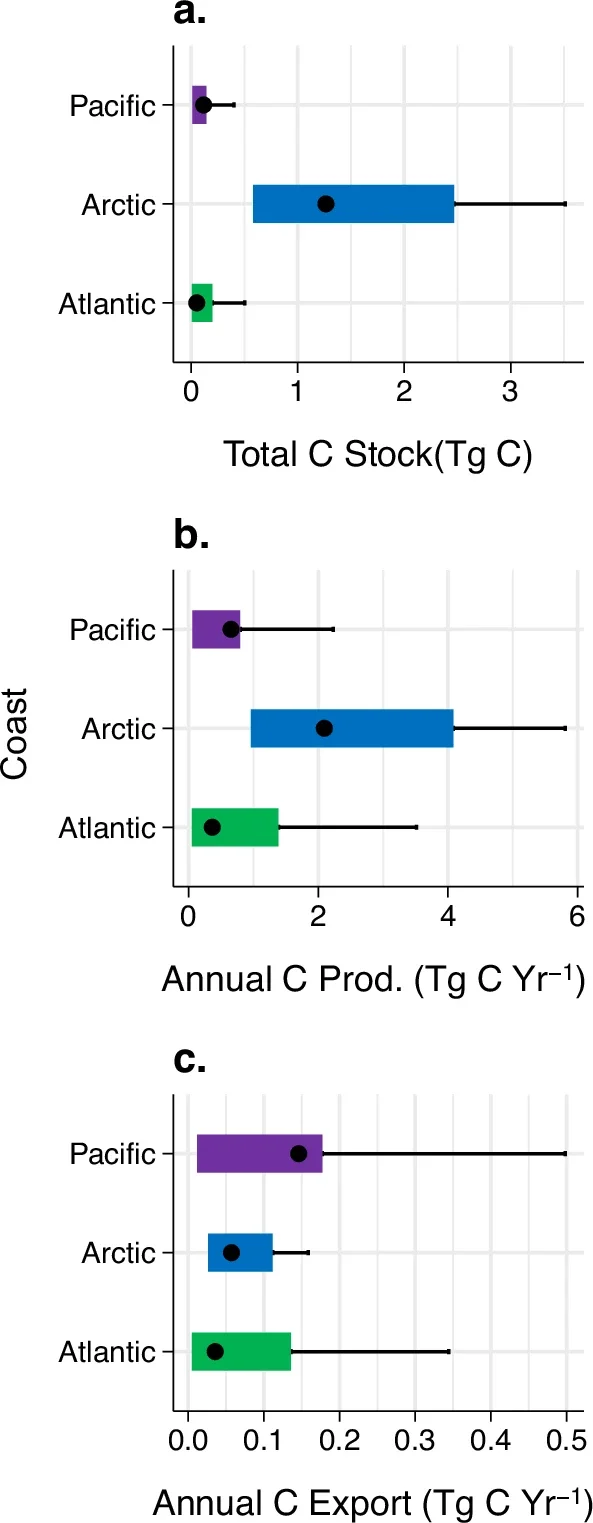
National blue carbon capacity of Canadian kelp forests. Panels show the total estimated (a) standing carbon stocks (Tg C), b carbon production (Tg C yr-1), and (c) carbon export (Tg C yr1) capacity of kelp forests. The bars depict the high and low estimates per coast. The circle represents the median estimates for each coast. Error bars show the maximum potential capacity per coast.